


 BACK
BACK
BLOGS
RESOURCES
What is Daily Management?
14 FEB 2019


Daily Management is concerned with completing ‘a day’s work in a day’. To be successful managing day to day we need to manage the following; Simple questions to identify problemsIs normal condition defined? Checks 5C/S, visuals, standards etc.Are there gaps between target and actual?Do we know where we are in real time?Was current standard work followed? Do we have it, is it current, do we use it? Why the gaps?How well do we understand the process?How will we close the gaps fully (P-D-C-A)? No ‘sticking plaster’ solutions, although containment may be required before root cause etc.?When can we review success and learning?Set expectations, if time scales are long this may also lead to escalation. Actions should also be on the visual management as ‘Rapid PDCA cycles’What are the benefits?Daily Management is used to achieve all three of the goals of TPM:
- work demand must be clearly understood which generates the plan.
- The plan has to be appropriately resourced with people, equipment, materials and information.
- Performance against the plan must be clear in real time.
- Finally the reason for any performance gap must be known.
- Activities that teams carry out to set standards
- Activities that managers undertake and are linked to the standards
- An escalation process
- Simple identification of problems
- 5S
- Standardised Work
- Visual Management
- Daily stand up review of performance using a PDCA approach
- Problem Solving and countermeasure thinking / continuous improvement
- Leaders walking the floor
- Teaching the Socratic way – with questions. Coaching
- Layered audits, (sometimes referred to as kamishibai)
- Lead by example
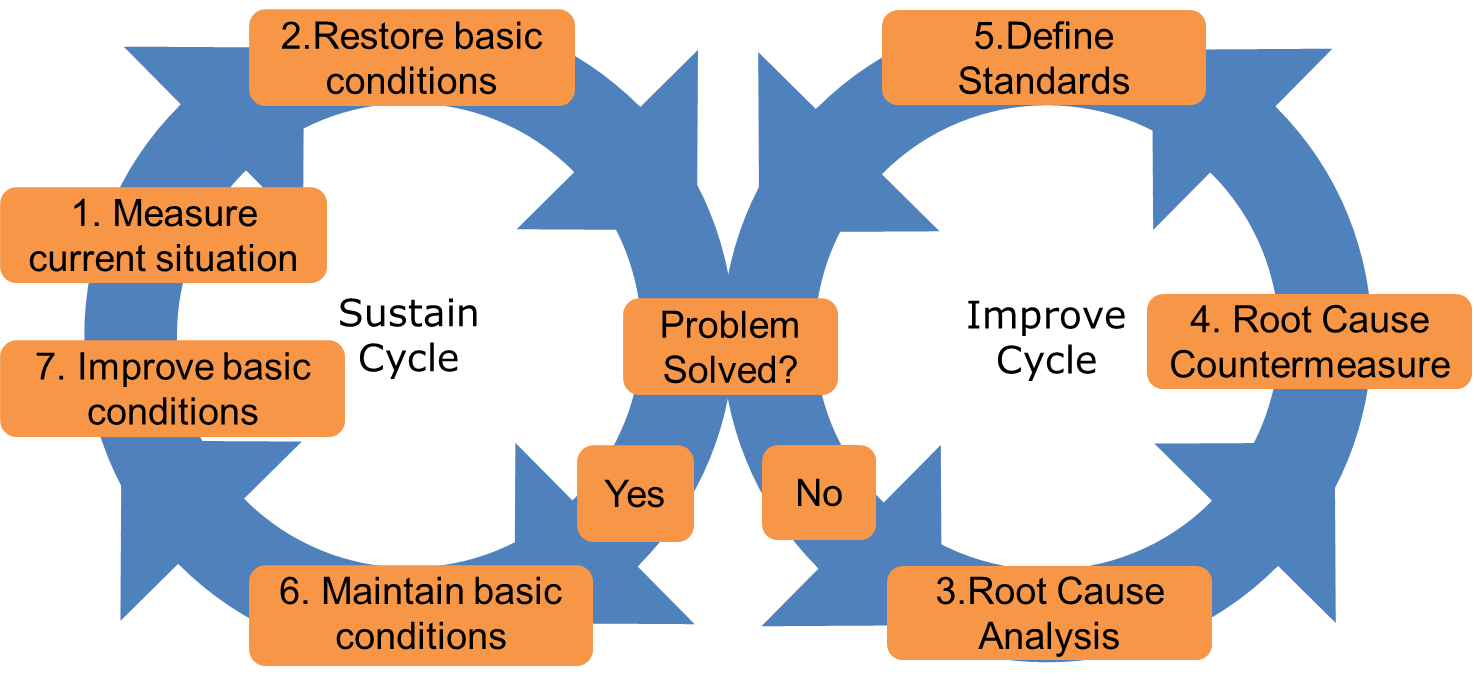 Simple questions to identify problemsIs normal condition defined? Checks 5C/S, visuals, standards etc.Are there gaps between target and actual?Do we know where we are in real time?Was current standard work followed? Do we have it, is it current, do we use it? Why the gaps?How well do we understand the process?How will we close the gaps fully (P-D-C-A)? No ‘sticking plaster’ solutions, although containment may be required before root cause etc.?When can we review success and learning?Set expectations, if time scales are long this may also lead to escalation. Actions should also be on the visual management as ‘Rapid PDCA cycles’What are the benefits?Daily Management is used to achieve all three of the goals of TPM:
- Zero accidents
- Zero defects
- Zero breakdowns
- Control
- Structure
- Clear processes
- Defined roles and responsibilities.
VIEW MORE RESOURCES
IN OTHER NEWS








 BACK
BACK 

 CONTINUE TO CHECKOUT

