


 BACK
BACK
BLOGS
RESOURCES
“In God we trust, all others must bring data.” – W. Edwards Deming
14 AUG 2019


Deming was champion of using data and measurement to properly understand and quantify current performance against standard. Understanding a problem through robust data collection and analysis provides a solid foundation to begin problem solving. It’s conventional wisdom, and has been around for a long time – all the more surprising then that the second biggest Major Non Conformance criteria in IATF 16949 for 2019 year to date is Clause 10.2.3 – Problem Solving!Problems, or abnormal occurrences, may be picked up in a number of different ways: Figure 1: The gap between actual and target performance.Typical performance measures include delivery, cost, lead time, safety and quality.It is important to remember that Problem Solving is not just used to react to a customer quality complaint.
 Figure 2: The Infinity Loop.In normal working situations, we are in the sustain cycle, the first step of which is to measure the current situation. The second step is to keep to standard and if required, restore basic conditions of the equipment. Basic conditions refer to the good 5S/5C condition, working to Standard Operations and equipment maintained at the correct level.We then ask “Has the problem identified in step 1 been resolved?” Typically, 8/10 problems are resolved by restoring basic conditions. In these cases, step 3 is to do what is required to maintain the basic conditions in order to sustain normal working conditions. In these instances, we do not need to deploy a structured problem solving technique.What happens if the problem isn’t resolved by restoring basic conditions? We now have a second route to take; the Improvement Cycle. This could be a Focussed Improvement activity using the tools of Problem Solving. In the improve cycle, step 3 becomes carry out a “root cause analysis”. Step 4 is “root cause countermeasure” and step 5 is “define standards”.We then ask the question, “Has this solved the problem?” If the answer is no, go round the improvement cycle again. If the answer is yes, then we return to the sustain cycle, and the old step 3 has become step 6. The final step is 7, improve the basic conditions in line with the countermeasure. Normal working is made up of a combination of these two cycles – called the infinity loop. The infinity loop has strong links with Total Productive Maintenance, especially the point of establishing and maintaining basic conditions.The second question asked when deciding if structured problem solving needs to be used is, “Is the cause and/or countermeasure to the problem known?”The table below demonstrates the different approaches to be taken, depending upon your knowledge of cause and countermeasure:
 Figure 3: Cause/Countermeasure MatrixThe matrix illustrates the different approaches that can be taken to solving a Problem, dependent upon your understanding of it. The cause may be known or not known, and similarly, the countermeasure may be known or not known. This leads to 4 different scenarios:
 A Bit More About Mike
Mike Scull has over 30 years of manufacturing experience within the automotive, aerospace, electronics, off highway, white goods and apparel sectors. Joining Industry Forum in January 1998, Mike underwent training and mentoring in the implementation of Lean Manufacturing with Japanese Master Engineers from Toyota, Nissan and Honda. Mike’s current role at Industry Forum is Principal Consultant – Lean Manufacturing.Mike is a Chartered Engineer (CEng MIMechE), and has a BSc (Hons) in Civil Engineering. He has professional qualifications including APICS Certified Supply Chain Professional (CSCP) and Certified Production and Inventory Management (CPIM), Certified Demand Driven Planner, PRINCE2 Practitioner and is a Certified Six Sigma Black Belt. He is also an Assessor for the National Manufacturing Competitiveness Levels (NMCL) programme.Click here to contact Mike.
A Bit More About Mike
Mike Scull has over 30 years of manufacturing experience within the automotive, aerospace, electronics, off highway, white goods and apparel sectors. Joining Industry Forum in January 1998, Mike underwent training and mentoring in the implementation of Lean Manufacturing with Japanese Master Engineers from Toyota, Nissan and Honda. Mike’s current role at Industry Forum is Principal Consultant – Lean Manufacturing.Mike is a Chartered Engineer (CEng MIMechE), and has a BSc (Hons) in Civil Engineering. He has professional qualifications including APICS Certified Supply Chain Professional (CSCP) and Certified Production and Inventory Management (CPIM), Certified Demand Driven Planner, PRINCE2 Practitioner and is a Certified Six Sigma Black Belt. He is also an Assessor for the National Manufacturing Competitiveness Levels (NMCL) programme.Click here to contact Mike.
- Measuring actual performance against target as in Figure 1 e.g. short interval monitoring, SPC charts, performance measures on a Visual Management Board.
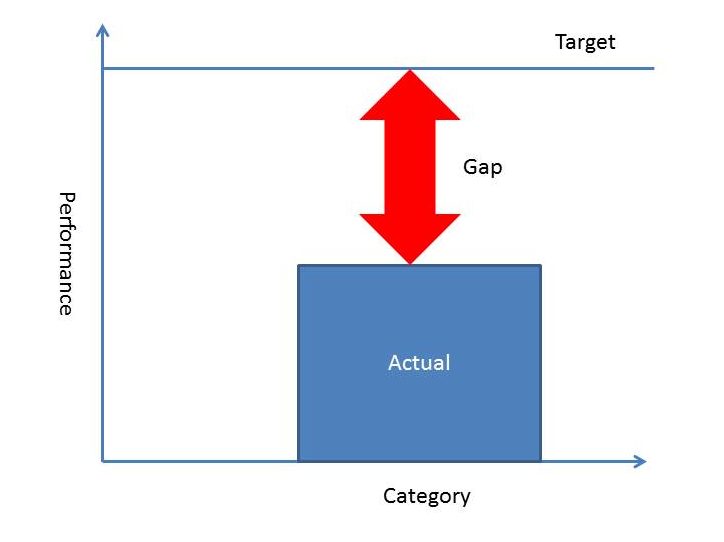 Figure 1: The gap between actual and target performance.Typical performance measures include delivery, cost, lead time, safety and quality.It is important to remember that Problem Solving is not just used to react to a customer quality complaint.
- Trend or data trail analysis as part of an improvement programme.
- Customer complaints.
- Accident log book.
- Observing for yourself at the place of work and by talking to those carrying out the process.
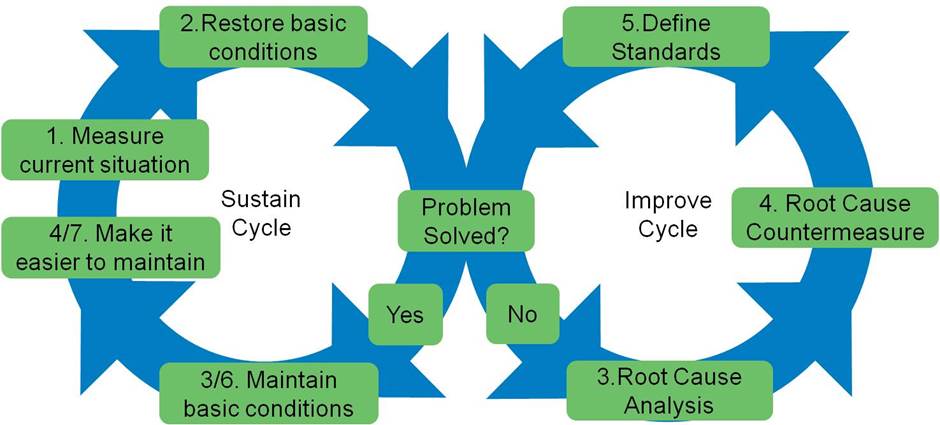 Figure 2: The Infinity Loop.In normal working situations, we are in the sustain cycle, the first step of which is to measure the current situation. The second step is to keep to standard and if required, restore basic conditions of the equipment. Basic conditions refer to the good 5S/5C condition, working to Standard Operations and equipment maintained at the correct level.We then ask “Has the problem identified in step 1 been resolved?” Typically, 8/10 problems are resolved by restoring basic conditions. In these cases, step 3 is to do what is required to maintain the basic conditions in order to sustain normal working conditions. In these instances, we do not need to deploy a structured problem solving technique.What happens if the problem isn’t resolved by restoring basic conditions? We now have a second route to take; the Improvement Cycle. This could be a Focussed Improvement activity using the tools of Problem Solving. In the improve cycle, step 3 becomes carry out a “root cause analysis”. Step 4 is “root cause countermeasure” and step 5 is “define standards”.We then ask the question, “Has this solved the problem?” If the answer is no, go round the improvement cycle again. If the answer is yes, then we return to the sustain cycle, and the old step 3 has become step 6. The final step is 7, improve the basic conditions in line with the countermeasure. Normal working is made up of a combination of these two cycles – called the infinity loop. The infinity loop has strong links with Total Productive Maintenance, especially the point of establishing and maintaining basic conditions.The second question asked when deciding if structured problem solving needs to be used is, “Is the cause and/or countermeasure to the problem known?”The table below demonstrates the different approaches to be taken, depending upon your knowledge of cause and countermeasure:
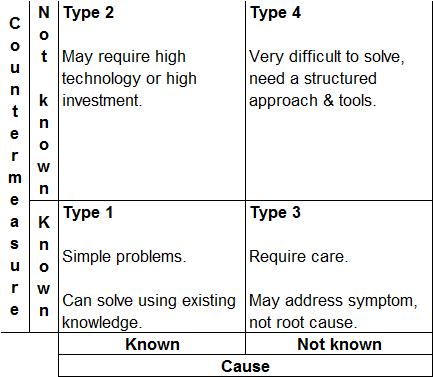 Figure 3: Cause/Countermeasure MatrixThe matrix illustrates the different approaches that can be taken to solving a Problem, dependent upon your understanding of it. The cause may be known or not known, and similarly, the countermeasure may be known or not known. This leads to 4 different scenarios:
- Type 1 where cause and countermeasure are both known. Existing knowledge can be applied to the solution of the problem and a simple process followed.
- Type 2 where cause is known and countermeasure is not known. This is where technology tends to get applied to resolve issues and process specialists are required.
- Type 3 where cause is not known and countermeasure is known. Beware that countermeasures, at this point, could be applied to symptoms of problems if that problem has not been fully understood – this is fire-fighting.
- Type 4 where neither cause nor countermeasure is known. This is the area where the structured approach is most useful. The root cause can be most effectively identified through a rigorous iterative process utilising all the information relevant to the problem.
- All the process inputs are being deployed as required (man, material, machine and method) i.e. basic conditions are being met.
- The cause for falling short of target is unknown.
- The countermeasure is unknown.
- Customer satisfaction – customer expects certain quality, price and delivery targets to be met and failure to meet these will reduce satisfaction, especially if the reason given for failure is repetitive.
- Competitiveness – poor QCD results affect the ability to compete with other suppliers and the achievement of globally competitive costs. Ultimately, this affects profitability.
- Reputation – a dissatisfied customer will be unlikely to repeat their business with you, and will likely spread the word to other people.
- Employee effectiveness.
- Prevents reoccurrence of problems (i.e. fire-fighting).
- In turn, this improves performance measures and customer satisfaction.
- Provides a structured methodology for improvement of products/processes by highlighting potential risks on similar processes.
- Reduces costs associated with the problem.
 A Bit More About Mike
Mike Scull has over 30 years of manufacturing experience within the automotive, aerospace, electronics, off highway, white goods and apparel sectors. Joining Industry Forum in January 1998, Mike underwent training and mentoring in the implementation of Lean Manufacturing with Japanese Master Engineers from Toyota, Nissan and Honda. Mike’s current role at Industry Forum is Principal Consultant – Lean Manufacturing.Mike is a Chartered Engineer (CEng MIMechE), and has a BSc (Hons) in Civil Engineering. He has professional qualifications including APICS Certified Supply Chain Professional (CSCP) and Certified Production and Inventory Management (CPIM), Certified Demand Driven Planner, PRINCE2 Practitioner and is a Certified Six Sigma Black Belt. He is also an Assessor for the National Manufacturing Competitiveness Levels (NMCL) programme.Click here to contact Mike.
A Bit More About Mike
Mike Scull has over 30 years of manufacturing experience within the automotive, aerospace, electronics, off highway, white goods and apparel sectors. Joining Industry Forum in January 1998, Mike underwent training and mentoring in the implementation of Lean Manufacturing with Japanese Master Engineers from Toyota, Nissan and Honda. Mike’s current role at Industry Forum is Principal Consultant – Lean Manufacturing.Mike is a Chartered Engineer (CEng MIMechE), and has a BSc (Hons) in Civil Engineering. He has professional qualifications including APICS Certified Supply Chain Professional (CSCP) and Certified Production and Inventory Management (CPIM), Certified Demand Driven Planner, PRINCE2 Practitioner and is a Certified Six Sigma Black Belt. He is also an Assessor for the National Manufacturing Competitiveness Levels (NMCL) programme.Click here to contact Mike.VIEW MORE RESOURCES
IN OTHER NEWS







 BACK
BACK 

 CONTINUE TO CHECKOUT

