


 BACK
BACK
BLOGS
RESOURCES
Is there still life in Manufacturing?
20 MAY 2019


Ever since the first industrial revolution people, businesses and cultures have strived to improve so to get the edge on their competition. History describes these in four stages. The first industrial revolution sees people using powered machines to perform tasks previously done by hand. The second industrial revolution, often referred to as the technological revolution included advances such as wide use of electric light, the telephone and machine advances which enabled more accurately produced interchangeable parts, paving the way for Mass Production. The third industrial revolution sees a shift from analogue to digital, resulting in computers and the dawn of the internet. The fourth industrial revolution, a term first coined in 2015, reflects perhaps the augmentation of many things that have gone before. Technological advances now enable everything to be detected in minute scales or time frames. Then information is processed simultaneously and comprehensively so to allow autonomous machines.The big question is where does that leave manufacturing today? All of these developments can be applied in the few leading edge and pioneering companies but not every business can make significant change overnight. For many there is a requirement to make the most of the current process in order to create the opportunities to invest in the process.
  Considering skills, many businesses face a challenge to attract people into manufacturing and this can lead to a risk that skills are lost as the workforce retires.For many small to medium companies it is a question of where to begin? What should be measured, where, when and how? Only then does it make sense to invest in technology and create a business case for change. To arrive at the right decision it is important to consider both the basic process model and how people interact with the process. The process needs to be defined in terms of inputs, methods and outputs and this need to be measured and controlled to ensure outputs meet standards. To achieve this effectively people need to have the appropriate process knowledge. This knowledge includes:
 The Japan Institute of Plant Maintenance has developed test to qualify operators in this area of basic skills. From their research, 440 companies have adopted this learning and certification. It applies across all sectors. In their terms, it is called “Monodzukuri” – which translates to the “art of manufacture.” Subjects include:
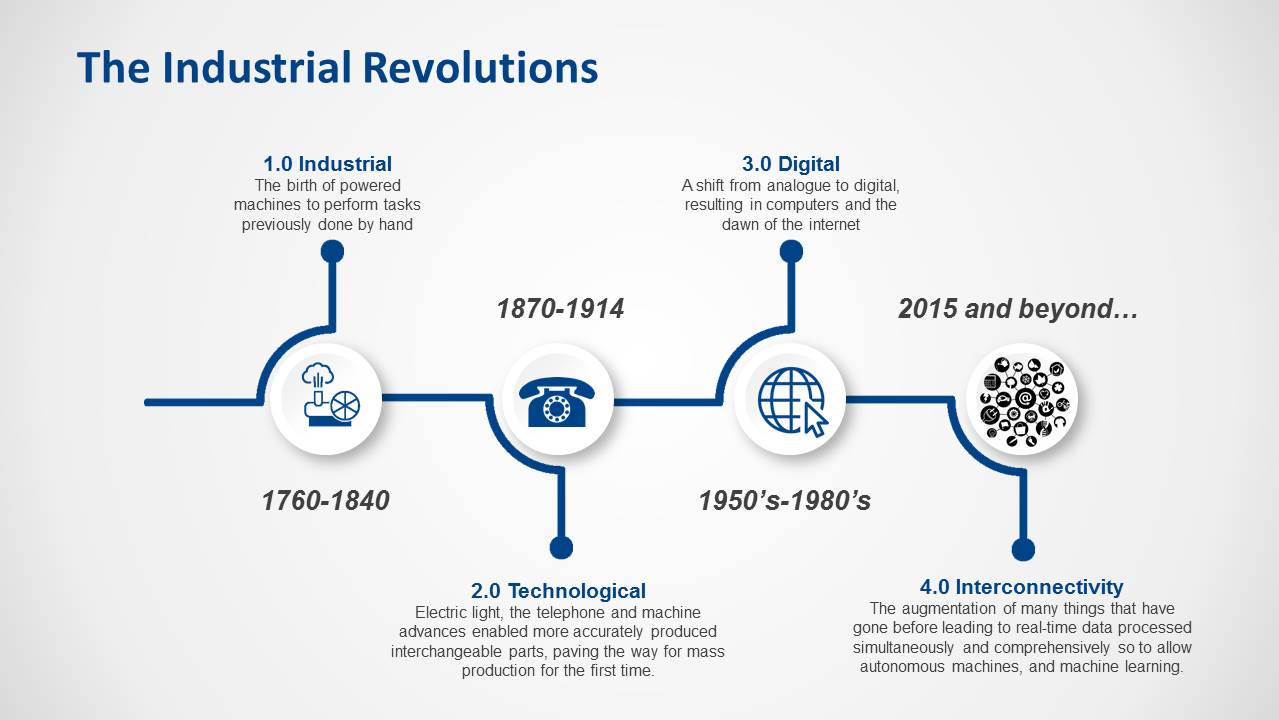 The first industrial revolution sees people using powered machines to perform tasks previously done by hand. The second industrial revolution, often referred to as the technological revolution included advances such as wide use of electric light, the telephone and machine advances which enabled more accurately produced interchangeable parts, paving the way for Mass Production. The third industrial revolution sees a shift from analogue to digital, resulting in computers and the dawn of the internet. The fourth industrial revolution, a term first coined in 2015, reflects perhaps the augmentation of many things that have gone before. Technological advances now enable everything to be detected in minute scales or time frames. Then information is processed simultaneously and comprehensively so to allow autonomous machines.The big question is where does that leave manufacturing today? All of these developments can be applied in the few leading edge and pioneering companies but not every business can make significant change overnight. For many there is a requirement to make the most of the current process in order to create the opportunities to invest in the process.
 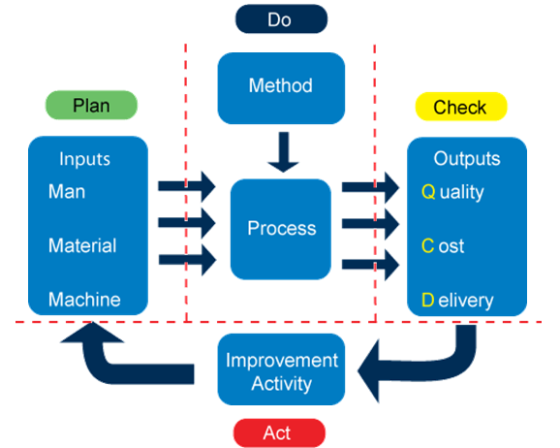 Considering skills, many businesses face a challenge to attract people into manufacturing and this can lead to a risk that skills are lost as the workforce retires.For many small to medium companies it is a question of where to begin? What should be measured, where, when and how? Only then does it make sense to invest in technology and create a business case for change. To arrive at the right decision it is important to consider both the basic process model and how people interact with the process. The process needs to be defined in terms of inputs, methods and outputs and this need to be measured and controlled to ensure outputs meet standards. To achieve this effectively people need to have the appropriate process knowledge. This knowledge includes:
- How to establish standards
- Basic engineering knowledge that relates to the process
- How to identify and solve problems
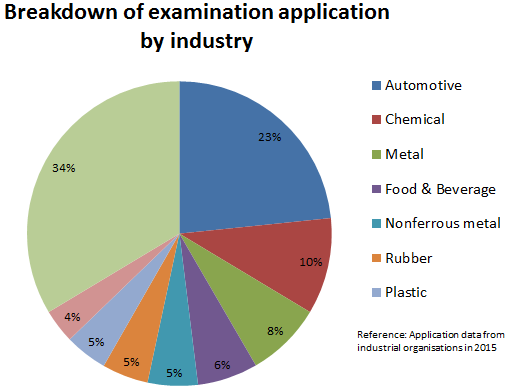 The Japan Institute of Plant Maintenance has developed test to qualify operators in this area of basic skills. From their research, 440 companies have adopted this learning and certification. It applies across all sectors. In their terms, it is called “Monodzukuri” – which translates to the “art of manufacture.” Subjects include:
- The basics of manufacture which is comprised of safety, quality, workplace organisation and standard work
- How to analyse process performance and make effective improvements
- Basic engineering skills including lubrication, fasteners, pneumatics, hydraulics and drive systems
- How to sustain improvements by putting the appropriate maintenance practices in place
VIEW MORE RESOURCES
IN OTHER NEWS






 BACK
BACK 

 CONTINUE TO CHECKOUT

