


 BACK
BACK
ARTICLES
RESOURCES
The Eight Pillars Of Perfection
18 JUN 2013


The following article reports on how Total Productive Maintenance (known to some as Total Productive Management) became a winning improvement tool for organisations worldwide and explains how you can put the TPM theory into practice where you work:In an increasingly competitive global market, the only way that companies in the manufacturing and process sectors can survive is by becoming more efficient. For many years, tools such as Lean, 5S, Value Stream Mapping and Six Sigma have been used to reduce waste. But while these tools may eliminate waste around machines, a recurring problem that many companies in the manufacturing and process industries face is equipment breakdown. So why are maintenance processes not that effective?When asked, many companies will say: “We’ve done TPM”. TPM means many things to many people. To some, it means maintenance personnel developing instructions and giving them to production operators to perform basic equipment maintenance. While this approach may have some short term benefits, it is often unsustainable, as operators are not given the appropriate skills and it’s seen as an initiative rather than a long-term, strategic culture change programme.If we want to find out more about the true meaning of TPM, let’s look at how it’s evolved.TPM was developed from the original preventive maintenance or productive maintenance (PM) concept and methodology introduced from the USA back in 1971. It’s been further developed and implemented in many Japanese companies, including the Toyota Group, and is now rapidly becoming a method that is applied worldwide.
In 2012, 10 people lost their lives working within the Heineken company, and, while this was a decline in comparison to the 27 fatalities of 2011, it was felt – understandably – to be completely unacceptable. Of the ten people who lost their lives, three were direct Heineken employees and seven were employed by contractors or suppliers. Six fatal accidents occurred in Mexico, two in Nigeria and one each in the Democratic Republic of Congo and Ethiopia.In order to combat such statistics, Heineken took on the TPM approach to drive improved continuous performance within the areas of safety, quality, customer service and leadership. TPM is fully embedded in Heineken breweries and is being further expanded across the entire supply chain and newly acquired businesses.Christopher Kerr, Director Global, Total Productive Management, explains: “We are able to leverage the tools, methods and systems of TPM to drive and support our Safety First Culture. In addition, the Heineken TPM Safety Pillar adopts a holistic approach and is regularly reviewed via benchmarking with best-in-class companies.“In recent years, we’ve re-defined our Pillar to establish a management system incorporating the five core elements of the safety compass principles: educative, proactive, reactive, managerial and directive. The Pillar is made up of a cross-functional group of people from line management mobilised to progress safety performance, with the vision and target always being zero accidents. Awareness, engagement and communication programmes are key Pillar activities, as well as setting yearly key activity indicators on the leading indicators, comprising of the number and execution of behavioural-based audits, machine risk assessments, identification of hazards and operational risk reduction as well the implementation of the Pillar tools, methods and systems.”These activities are managed via focused teams involving all layers of the organisation and the Safety Pillar is audited twice a year by a member of a global audit team. Performance is measured against the combined criteria of results and the effective use of the standards and tools.Heineken has also developed a contractor safety toolbox to help reduce the number of accidents among contractors. The toolbox consists of safety cards for each contractor activity showing what has to be checked before starting a job, as well as the dos and don’ts of the job itself. As Christopher Kerr says: “Our safety performance is steadily improving, and it remains our first priority; every accident is one accident too many.”
Global success
In 1971, Nippon Denso Co first introduced and successfully implemented TPM in Japan. They won the Japan Institute of Plant Maintenance (JIPM) PM Excellent Plant Award for their activities. And this was the beginning of TPM in Japan. Since then, TPM has spread throughout Japan, especially in the Toyota group. The first example of TPM used in Europe to deliver world class performance was by Volvo in Ghent, Belgium. Volvo won the PM prize for their work in the paint shop, demonstrating evidence of reducing breakdowns and improving productivity. This was quickly followed in the early 1990s by other European automotive companies trying to close the productivity and quality gap to their Japanese competitors.“TPM has been implemented in many Japanese companies, including the Toyota Group, and is now rapidly becoming a method that is applied worldwide”
Since the JIPM TPM awards were founded, over 3,000 organisations have won awards, including Unilever, Wrigley, Tetra Pak, Heineken and Arcelor Mittal. The first level excellence award typically takes three years of TPM implementation and up to 15 years to achieve. To win an award, an organisation has to demonstrate, through a two-stage assessment process, effective application of TPM and achievement of less reduction.For the 2012 TPM ceremony, 12 Tetra Pak sites won awards, bringing their total to 70 awards over 12 years. The company’s La Rioja plant in Argentina received the prestigious Advanced Special Award for TPM Achievement at the 2012 award ceremony, reflecting the success it has seen since they began implementing TPM methodology in 2000. During his keynote presentation at the awards ceremony, Marcelo Loiacono, Production Manager at the La Rioja factory, said: “We started adopting the TPM methodology 12 years ago. Since then, we have turned one of Tetra Pak’s smallest converting plants into a facility which offers the shortest market lead time for customers. This achievement wouldn’t have been possible without a team-wide commitment to continuously driving operational performance improvement, supplying products of the highest quality, in the fastest lead-time, at the lowest possible cost.”Defining moment
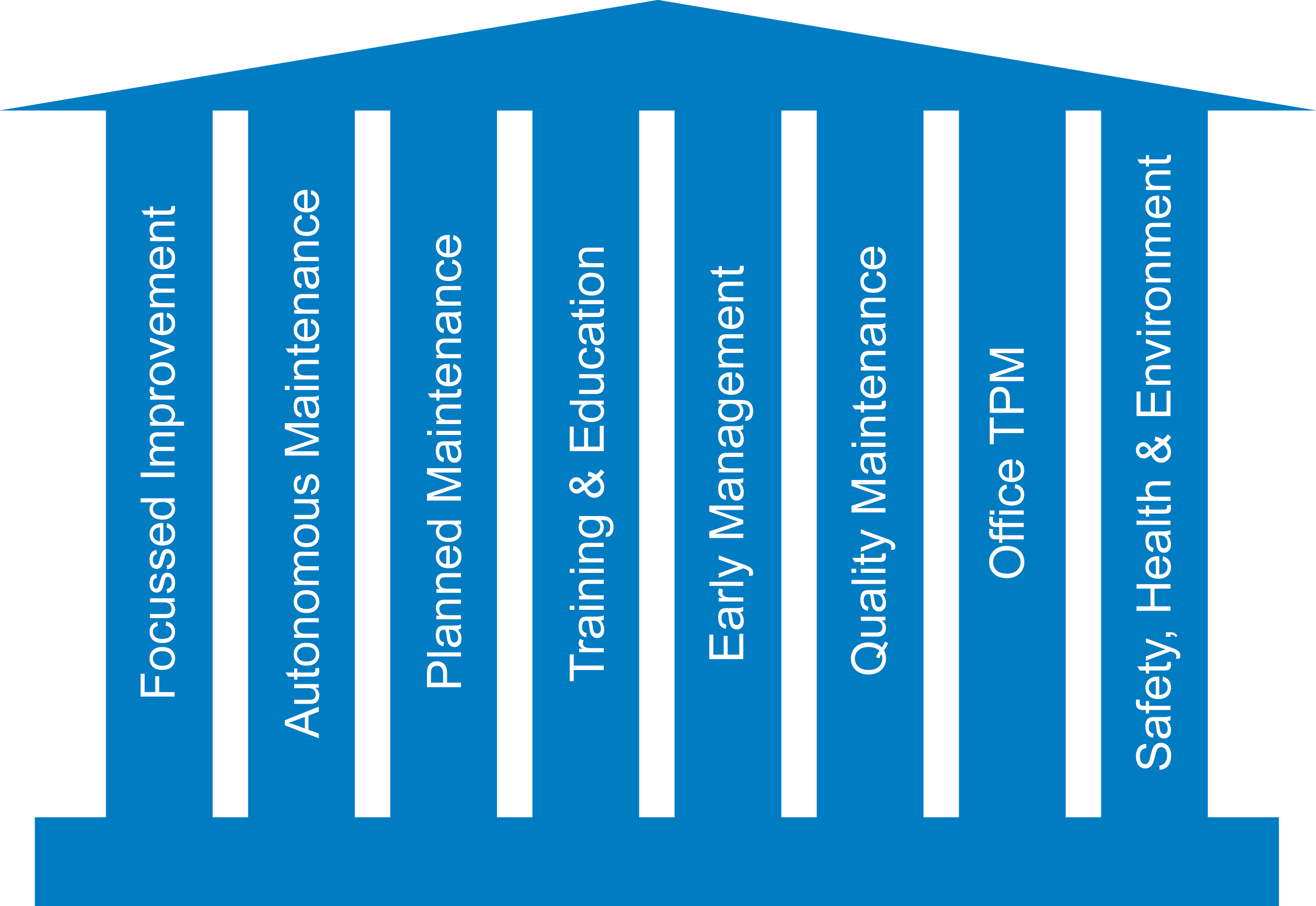
The JIPM definition of TPM is:Total – must involve all employees at all levels of the organisationProductive – effective use of all resourcesMaintenance – keeping the man-machine-material system in optimum condition.JIPM developed an eight pillar approach to TPM focused on achieving:The structure of JIPM’s TPM model is based on eight pillars as shown below. Each pillar has a well-defined step-by-step approach to implementation.
- Zero accidents
- Zero breakdown
- Zero defects
Putting Theory Into Practice
The mission of each pillar is to reduce loss with the ultimate aim of elimination of all losses. So how does an organisation start a TPM programme using this JIPM model? Firstly, top management need to understand that TPM is part of a long-term culture change programme, not just an initiative for the maintenance department. A TPM champion needs to be appointed and pillar leaders defined.Next, a pilot area needs to be identified. Typically, this is selected based on reviewing data on breakdowns and quality issues. The operators involved in the area, along with other functions such as maintenance and quality, are then trained in the principles of TPM and what role they will play in the implementation of autonomous maintenance. In simple terms, autonomous maintenance is giving more responsibility to the operators to care for their own machines.The machine operation is discussed within the team and any safety risks are identified in preparation for the first inspection and cleaning activity. This is more than just a machine clean up: the team inspects the machine in minute detail, often identifying problems that have built up over years. Each problem is tagged and logged. Responsibility to address each issue needs to be decided. In the early days of TPM implementation, most issues will need to be fixed by maintenance as the operators will have insufficient skills.The team then needs to define cleaning and inspection standards to maintain the improvements made (step one of autonomous maintenance). After a period of stability – typically three to six months – the team starts work on trying to reduce cleaning and inspection time by eliminating sources of contamination and making inspections easier to perform (step two of autonomous maintenance).At this stage, although operators typically feel more engaged and there is improved teamwork with other functions such as maintenance, new skills have not been learnt. However, a reduction in breakdowns and minor stops should already be visible.Steps three and four of autonomous maintenance address the training issue. In step three, operators are trained to undertake some basic maintenance tasks, such as lubrication, while in step four training continues in other tasks subjects such as hydraulics, drive systems, pumps and valves. Completing autonomous maintenance to step four can often take up to three years. Once management is convinced that this approach delivers results, they develop a master plan to roll out across the whole company.In parallel with this autonomous maintenance activity, work is ongoing with the other pillars, and losses are reduced using the same structured step-by-step approach. While this may take a massive investment of time and resource, the step-by-step approach has been proven to deliver results.Proven Results
In September 2005, Sheffield-based Outokumpu Stainless Steel, manufacturer of stainless steel and high performance alloys, began implementing a TPM programme, called OK>1. Ian Wallace, Continuous Improvement Manager, told QW: “Before introducing TPM, our principles for working were that the equipment was owned by the operations department; maintenance activities were carried out by engineers working within the production teams; improvements were mainly initiated by engineers; simple checks, easy lubrication tasks and small repairs were performed by operators; there were no structural root cause analyses or countermeasures for breakdowns; and we did not have a business cost and loss deployment.”“Rushing implementation has been proven not to work”
Since the introduction of TPM, Outokumpu has seen some real improvements: the equipment is owned by the operators, who get support from a small number of process improvers. Improvements are initiated by operators and process improvers, based on contribution to company KPIs. Both autonomous maintenance and planned maintenance activities are undertaken by operators. Operators also undertake simple and complex repairs of their machines and equipment, while mechanical technical advice is available from a small team of engineering managers.The benefits are clear, according to Ian. “We haven’t had a lost time accident (no work days lost through accidents) in the last four years. This has been achieved by a concerted effort to change our culture. TPM plays a major part in the culture change. We need to beat our competitors in customer satisfaction, and to ensure customer satisfaction we have to deliver low cost good quality product on time and in full.“From a manufacturing point of view, our vision is to have a safe, clean and well-organised plant where cost and losses are understood and which is easy to maintain. Our people are fundamental to that process. We have a flexible and well-motivated workforce, which responds positively when asked to work above and beyond expected norms. Continuous improvement is ‘business as usual’ at our plant. It’s the only way to work and it delivers results.”Organisations should think long and hard before embarking on a TPM journey, because it needs to be part of strategic culture change programme if it is to deliver long-term sustainable results. It also needs to be driven by top management and involve everyone. Selection of a pilot area is a key to success. Once the benefits are seen, TPM can be rolled out across an organisation to a defined master plan, but don’t rush implementation – this has been proven not to work.Case Study
 Heineken finds the right approach to safety with TPM
In 2012, 10 people lost their lives working within the Heineken company, and, while this was a decline in comparison to the 27 fatalities of 2011, it was felt – understandably – to be completely unacceptable. Of the ten people who lost their lives, three were direct Heineken employees and seven were employed by contractors or suppliers. Six fatal accidents occurred in Mexico, two in Nigeria and one each in the Democratic Republic of Congo and Ethiopia.In order to combat such statistics, Heineken took on the TPM approach to drive improved continuous performance within the areas of safety, quality, customer service and leadership. TPM is fully embedded in Heineken breweries and is being further expanded across the entire supply chain and newly acquired businesses.Christopher Kerr, Director Global, Total Productive Management, explains: “We are able to leverage the tools, methods and systems of TPM to drive and support our Safety First Culture. In addition, the Heineken TPM Safety Pillar adopts a holistic approach and is regularly reviewed via benchmarking with best-in-class companies.“In recent years, we’ve re-defined our Pillar to establish a management system incorporating the five core elements of the safety compass principles: educative, proactive, reactive, managerial and directive. The Pillar is made up of a cross-functional group of people from line management mobilised to progress safety performance, with the vision and target always being zero accidents. Awareness, engagement and communication programmes are key Pillar activities, as well as setting yearly key activity indicators on the leading indicators, comprising of the number and execution of behavioural-based audits, machine risk assessments, identification of hazards and operational risk reduction as well the implementation of the Pillar tools, methods and systems.”These activities are managed via focused teams involving all layers of the organisation and the Safety Pillar is audited twice a year by a member of a global audit team. Performance is measured against the combined criteria of results and the effective use of the standards and tools.Heineken has also developed a contractor safety toolbox to help reduce the number of accidents among contractors. The toolbox consists of safety cards for each contractor activity showing what has to be checked before starting a job, as well as the dos and don’ts of the job itself. As Christopher Kerr says: “Our safety performance is steadily improving, and it remains our first priority; every accident is one accident too many.”
Industry Forum’s TPM Courses
To enquire about Total Productive Maintenance:
VIEW MORE RESOURCES
IN OTHER NEWS



 BACK
BACK 

 CONTINUE TO CHECKOUT

